Top Picks by Budget & Style

Written by Patrick (Producer & Editor)
Affiliate disclosure: We may earn a commission from links on this page, at no extra cost to you.
Looking for the best synthesizers 2025 that actually helps you finish tracks? This guide narrows the field to a few stand-out instruments by budget and vibe – tested for sound in a mix, hands-on speed, and reliability. Links may earn us a commission at no extra cost to you.
Contents
- 1 TL;DR – Best synthesizers 2025 at a glance
- 2 Introduction
- 3 Best synthesizers 2025 – Our Top Picks
- 4 How to choose your best synthesizers 2025
- 5 Best synthesizers 2025 by Budget
- 6 Best synthesizers 2025 by Use-Case / Genre
- 7 Best Synthesizer 2025 – Our Top Picks (Comparison Table)
- 8 Quick Patch Recipes
- 9 Analog vs Digital vs VA (what actually matters in practice)
- 10 Best synthesizers 2025 – Methodology
- 11 Conclusion & Next Steps
- 12 About the Author
- 13 FAQ
- 14 Glossary
TL;DR – Best synthesizers 2025 at a glance
- Best Overall (all-rounder poly): Korg Minilogue XD – musical sweet spots, quick workflow, great value.
- Best Flagship: Oberheim OB-X8 – classic OB tone spanning X/Xa/OB-8 with modern polish.
- Best Over $1,000: Arturia PolyBrute 12 – huge expressive range, deep modulation, beautiful motion for pads and leads.
- Best Under $1,000: ASM Hydrasynth Desktop – modern wavemorphing engine, powerful mod matrix, performance macros.
- Best Under $500: Arturia MicroFreak – multiple engines, playful modulation, arp/seq; extremely creative for the money.
- Best Beginner: Korg Monologue – knob-forward layout, instant feedback; teaches synthesis while sounding great.
- Best Desktop (no keys): Roland SE-02 – classic leads/bass, built-in sequencer, patch memory.
- Best for Techno Bass: Dreadbox Typhon – analog core + deep FX for dark, heavy lines.
- Best for Ambient/Textures: Sonicware LIVEN Ambient Ø – four-layer ambient groovebox with lush FX & line-in.
- Best Semi-Modular: Moog Grandmother – pure hands-on patching, great filter and spring reverb; perfect bridge into modular.
- Runner-up: Sequential Prophet-6 – modern-built VCO classic with instant sweet spots, HPF+LPF tone shaping, tasteful onboard FX, and that unmistakable Sequential punch.
Tip: If you don’t need keys, desktop units save money and space while staying fully MIDI-controllable.
Introduction
Choosing a synth should feel inspiring, not like homework. This guide cuts through spec sheets and puts real studio needs first: how fast you can go from idea to sound, how intuitive the controls feel under your hands, and where each instrument truly shines. Rather than listing everything on the market, we focus on clear winners by budget and use-case – so you can make a confident decision without getting lost in options.
You’ll find short, readable product sections with what each synth does best, what to watch out for, and a quick patch recipe you can try on day one. We also include simple comparison tables, a practical “how to choose” chapter, and a small glossary to keep jargon out of your way. For convenience, every pick links to multiple shops so you can check price and availability where you actually buy. The goal is simple: less time researching, more time making music.
If you’re just starting out, begin with the beginner or under-$500 picks. If you already know your sound, jump to the category that matches your workflow – techno bass, ambient textures, live rigs, or compact desktops. Either way, the structure below will help you decide fast and move on to writing tracks with the best synthesizers 2025.
Best synthesizers 2025 – Our Top Picks
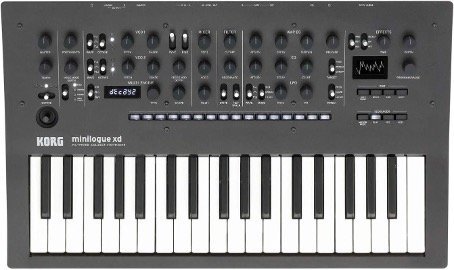
Korg Minilogue XD — the do-it-all poly that stays fun
A four-voice analog poly with a fast, knob-forward workflow and a clever digital “multi-engine” on top – easy to learn, big enough to keep.
Best for
Producers who want one keyboard that teaches synthesis while covering bass, plucks, pads, and modern textures—without drowning in menus.
Sound & engine (plain-English)
Start with two analog VCOs (saw/triangle/square + waveshape), then layer in the multi-engine for digital bite or specialty oscillators. The filter delivers musical sweeps; drive adds grit without killing clarity. You can go classic (warm poly pads), punchy (detuned unison), or modern (user oscillators/effects) and still keep a simple, “what I touch is what I hear” feel.
Workflow & learning curve
It’s built to learn by doing. The oscilloscope shows waveform changes as you tweak waveshape or modulate with the LFO; most routings are fixed so you don’t have to plan a matrix. When you’re ready to go deeper, add a user oscillator or effect and save it via the librarian—instant expansion without a new synth.
Highlights & Watch-outs
Quick patch recipe — “Wide pad in 60 seconds”
- VCO1: saw; VCO2: saw one octave up; detune VCOs slightly.
- Reverb: on; set time/depth to taste.
- VCF: cutoff around 11 o’clock; a touch of drive; modest resonance.
- Amp EG: small attack, full decay, some sustain, gentle release.
- EG2 → cutoff (positive): long attack + decay for a slow filter sweep; LFO → cutoff at a slow rate for subtle motion. Optionally bring in the digital oscillator for sheen.
Alternative best synthesizers 2025 to audition next
Arturia MiniFreak (deeper mod matrix, broader engines), ASM Hydrasynth Desktop (modern wavemorphing + macros), Korg Minilogue OG (simpler, cheaper used).
Check Price
Get the best deal now.
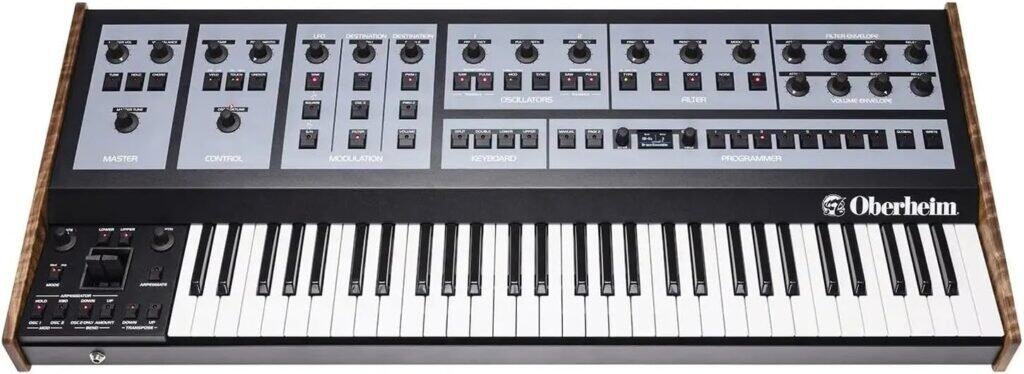
Oberheim OB-X8 — classic OB tone spanning X/Xa/OB-8 with modern polish
An eight-voice VCO analog poly that unifies OB-X, OB-Xa, and OB-8 flavors in one instrument – split/layer bi-timbrality, stereo pan modes, and extra SEM-style HP/BP/Notch filter types, all accessible via the infamous Page 2.
Best for
Flagship analog poly duties: expressive pads, OB brass, vintage-leaning pop/film cues, and stage setups that need split/layer flexibility without external processing.
Sound & engine (plain-English)
Two discrete VCOs per voice feed classic OB low-pass filters (selectable OB-X/OB-Xa/OB-8 behaviors), plus SEM-style modes via Page 2. Envelope/LFO “eras” alter feel and snap, while stereo pan-spread makes chords feel wide yet solid. It’s unmistakably Oberheim—polished, musical, and big without cranking FX.
Workflow & learning curve
Front-panel immediacy for the essentials; deeper options (filter types, pan behaviors, vintage variance, etc.) live on Page 2. Split/Double is quick to set, and performance levers + detune/unison deliver expressive leads on cue.
Build & I/O
Pro-level chassis and keybed, stereo outs, MIDI, and the expected performance controls. It’s a studio-and-stage flagship—big, solid, and voiced for records.
Highlights & Watch-outs
Quick patch recipe — “Wide OB pad, gently moving”
- Pan mode: Splayed or Spread; width = Full.
- Osc: both saw; tiny detune on Osc2.
- Filter: OB-Xa 4-pole LP; cutoff ~11 o’clock; res low; key-track ~50%.
- Env: Amp A 400–600 ms / R 800–1000 ms; Filter A 250–400 ms with small positive amount.
- LFO: slow triangle to PWM or cutoff (very shallow).
- Page 2 (optional): switch to SEM band-pass and blend a touch for airy mids.
Bonus ideas
• Split Upper/Lower: warm pad below + brighter OB-X brass on top; balance layers for narrative swells.
• Unison lead: engage unison, moderate detune, filter env pop—instant heroic lead.
Alternative best synthesizers 2025 to audition next
Arturia PolyBrute 12 (morphing expressiveness, modern mod depth), Waldorf Iridium (digital flagship: granular/wavetable/FM + FX).
Check Price
Get the best deal now.
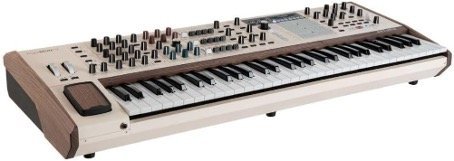
Arturia PolyBrute 12 — expressive poly with huge motion
A performance-first analog poly that turns movement into part of the sound—morph scenes, play an ultra-expressive keybed, and shape big, modern tones fast.
Best for
Evolving and cinematic pads, expressive leads, modern analog textures where performance gestures matter.
Sound & engine (plain-English)
Pro studios keep it around as one of the best synthesizers 2025 for classic poly roles. Expect big, modern analog tone with animated character. The dual-filter architecture gives you both creamy ladder shapes and more aggressive Steiner colors; morphing turns static patches into performances. With filter panning and stereo spread you can get width without drowning everything in reverb. It’s the kind of polysynth that fills space politely when you want it to – and dominates when you ask it to.
Workflow & learning curve
The front panel keeps the oscillator → filter → envelope flow obvious. Build Scene A (darker), flip to B (brighter/airier), then “play” the morph with the pad, ribbon, or aftertouch. Use the Motion Recorder for one-hand macro moves. In practice: save a few performance-ready templates with mapped morph/aftertouch so writing sessions stay quick.
Build & I/O
Metal/wood chassis, premium controls, and a distinctive vented top (the red glow isn’t just for looks; the passive cooling avoids fans). Around the back: MIDI in/out/thru, USB, three pedal inputs, sync in/out, memory-protect toggle, main outs; headphones are front-mounted. It’s built to live at the center of a rig.
Highlights & Watch-outs
Quick patch recipe — “Wide breathing pad”
- Two saws, slight detune for width.
- Filter ~11 o’clock, low resonance.
- Amp env: slow attack, medium decay, long release.
- Slow LFO → filter cutoff (subtle depth).
- Morph: Scene A darker/closed; Scene B brighter/airy. Sweep via aftertouch.
Alternative best synthesizers 2025 to audition next
UDO Super 6 (stereo magic, different feel), Prophet Rev2 16-Voice (modulation monster with great sound), Moog Subsequent 37 (if you realise you’re mono-focused).
(These keep the same “performance-forward” mindset at different sizes and flavors.)
Check Price
Get the best deal now.
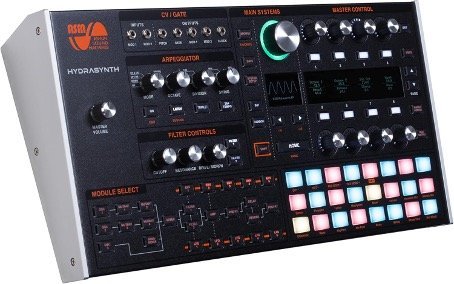
Best under $1,000
ASM Hydrasynth Desktop — modern wavemorphing engine
Desktop price, flagship ideas—morphing oscillators, a generous mod matrix, and performance macros that make futuristic tones feel immediate.
Best for
Modern pads and textures, morphing plucks, percussive digital bits, experimental sequences, and macro-driven live tweaks.
Sound & engine (plain-English)
For value hunters, this sits firmly in the best synthesizers 2025 under $1,000. Hydrasynth feels like shapeshifting digital: clean when you want it, aggressive when pushed. Start with a custom WaveScan table, then let Mutants (FM/PWM and friends) push it into new territory. The matrix lets you map movement precisely—LFOs can drive the scan position, mutants, filter brightness, or even macro knobs—so a single patch can travel far without ever leaving the instrument. Filters cover multiple characters (Moog-ish models with bass-friendly resonance behavior, MS-20-style options, and the “Threeler”), so you’re not stuck with one “house” tone.
Workflow & learning curve
Sections are laid out as physical buttons that light up; the Master Control screen/encoders show only what matters for that section. It’s a rare deep synth where you can route LFO→destination in seconds and keep playing. The encoders have great “ballistics” (slow = fine, fast = big jumps), so dialing is precise. If you like templates, save a starter patch with your favorite macro assignments and mod slots—then every new sound is minutes away.
Build & I/O
Compact desktop chassis; MIDI DIN + USB; audio outs and headphone; integrates neatly with DAWs and hardware clocks. If you need keys or more voices/layers, the Deluxe doubles the engine (one 16-voice or two 8-voice layers) and the Explorer shrinks the footprint while keeping the core sound.
Highlights & Watch-outs
Quick patch recipe — “Glass morph pluck”
- Pick a bright wavetable and fill the 8-slot WaveScan list with related frames.
- Amp env: short attack/decay, low sustain, short release.
- Filter: small attack “nip,” then open quickly.
- Macro 1 = WaveScan position; Macro 2 = subtle chorus; Macro 3 = a hint of delay.
- Velocity → amp amount for dynamic hits.
Alternative best synthesizers 2025 to audition next
UDO Super 6 (stereo magic, different feel), Prophet Rev2 16-Voice (modulation monster with Modal Argon (a different wavetable flavor), Korg Modwave (deep motion lanes), Hydrasynth Keys/Deluxe (if you want a keybed or dual layers).
Check Price
Get the best deal now.
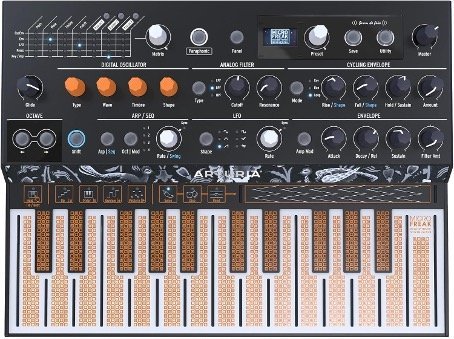
Arturia MicroFreak — playful sound lab under $500
A compact, paraphonic synth with a multi-engine digital oscillator, a SEM-inspired analog filter, and a mod matrix that makes creative sounds stupid-easy.
Best for
Beginners and tinkerers who want maximum variety and fast results under $500: evolving textures, talky formants, plucky sequences, weird percussion, quick chords.
Sound & engine (plain-English)
The MicroFreak starts where many budget synths end. You pick one oscillator model (VA, Wavetable, Granular, Speech, Formant, etc.), then sculpt it through the multimode analog filter. Because engines include user wavetables/samples and granular options, you can move from classic synth tones to vocal-ish timbres, metallic plucks, and smeared ambient beds without leaving the panel. The result: a tiny box that spans “cute to unhinged” with a few knob turns.
Workflow & learning curve
The matrix panel is the star: choose a source, tap a destination, set amount. Add the Cycling Envelope as a looping mod source when you want LFO-like shapes with envelope curves (Rise/Fall/Hold/Sustain). For performance, lean on Dice/Spice to mutate sequences, Scale mode to stay in key, and enable Click-to-Load so you don’t nuke unsaved patches by bumping the preset encoder. Knob-catch modes (Jump/Hook/Scaled) keep hardware vs. saved values sane.
Build & I/O
25-key capacitive keyboard with pressure/aftertouch options; MIDI TRS Type B (adapters included), USB MIDI, CV/Gate outs for modular control, audio out/headphone. Vocoder works via the TRRS mic input on the headphone jack (compatible mics or splitter required). Portable, powerable via USB/power bank.
Highlights & Watch-outs
Quick patch recipe — “Evolving vowel pad (paraphonic)”
- Osc: choose Speech or Formant; set a slow scan through vowels.
- Paraphonic ON; play 2–4-note shapes.
- Filter: low-pass, cutoff ~11 o’clock, light resonance.
- Cycling Env → cutoff (slow Rise/Fall), LFO → formant/vowel (slow rate).
- Add Sequence A with 2–4 bars and record 1–2 mod tracks for gentle motion; ride Spice for subtle variation.
Alternative best synthesizers 2025 to audition next
Arturia MiniFreak (dual engines + FX, bigger keys), Modal Argon8 (wavetable flavor), Korg Monologue (analog mono if you want raw VCO tone).
Check Price
Get the best deal now.
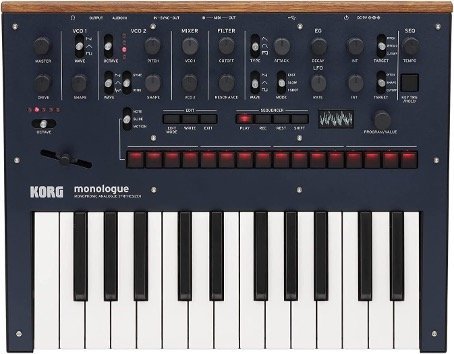
Korg Monologue — punchy, hands-on mono that teaches fast
A compact analog monosynth built for immediate bass/lead results and learn-by-doing synthesis—cheap to own, fun to sequence, hard to outgrow.
Best for
Immediate acid/techno bass, gritty leads, sequenced riffs, and drum-style step tricks with motion recording.
Sound & engine (plain-English)
VCO1 (saw/tri/square with waveshape) + VCO2 (tunable, syncable) feed a resonant filter and a drive that adds bite without mud. Send the envelope to pitch, pitch2, or cutoff for classic punch or sync-screams; flip on ring mod for metallic edge. The character is focused and assertive – what you dial is what you hear – so it sits in a mix fast.
Workflow & learning curve
As one of the best synthesizers 2025 for beginners, it teaches synthesis fast. This is learn-by-doing synthesis: left-to-right panel, obvious routing, and a sequencer that rewards small per-step tweaks. Use LFO one-shot for envelope-like zaps, try Key-Trig to rhythmically re-arm the LFO, and lock a few parameters per step to “drum-program” your bassline. There’s portamento in menus and BPM-sync for LFO to keep patterns tight. Bonus: it’ll even run on batteries for couch sessions.
Build & I/O
Lightweight yet well-built; designed to be thrown in a backpack. (Exact I/O isn’t the Monologue’s story here; the headline is portability + sequencing fun.). Another reason why it made it in the list of our best synthesizers 2025.
Highlights & Watch-outs
Quick patch recipe — “Acid bass with drum accents”
- VCO1: square; VCO2: saw, a 5th up; enable SYNC.
- Filter: cutoff ~10–11 o’clock; a touch of resonance; drive at 10–11 o’clock.
- LFO: one-shot → cutoff; set fast rate/medium amt for a “nip” at note start.
- Seq (16 steps): record notes; motion-record cutoff/resonance/drive on a few steps for accents.
- Optional: per-step VCO2 level for pseudo-kick/snare hits; try Key-Trig to retrigger LFO on downbeats.
Alternative best synthesizers 2025 to audition next
Novation Bass Station II: deeper engine, bigger keys; a bit harsher to some ears, IK UNO Synth Pro (desktop): dual filters, broader mod matrix, cheaper build, Cre8Audio East Beast / West Pest: tiny semi-modular flavor, no real keys, Arturia MicroFreak: digital chameleon; not analog, but shockingly versatile under $500.
Check Price
Get the best deal now.
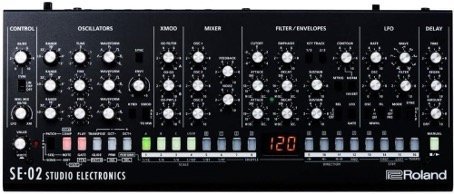
Roland SE-02 — tiny module, big vintage attitude
A triple-VCO analog mono in a compact Boutique box – fat bass/leads, onboard sequencer and delay, plus clever cross-mod tricks when you want bite.
Best for
Classic and modern mono sounds: techno/acid bass, lead lines with growl, and sequenced riffs that benefit from onboard delay and cross-mod flavor.
Sound & engine (plain-English)
Think classic ladder-style weight with modern conveniences. Three VCOs give you stacked thickness or creative modulation duties; Osc 3 can become a modulation workhorse (e.g., PWM or filter FM) because it can run free from keyboard pitch. The feedback path turns polite patches into gritty, mix-ready tones. Add the internal delay and you’ve got instant analog hooks without a pedal chain.
Workflow & learning curve
The panel is dense but logical: oscillators to the left, filter/envelopes in the middle, LFO and cross-mod close by, and sequencer/delay on the right. Program a 16-step line, then nudge oscillators, feedback, and cutoff while it runs – small moves go a long way. For live sets, save a few “safe” ranges and practice the Osc 3 modulation sweet spots so you can push aggression without losing tuning.
Build & I/O
Boutique-sized metal/plastic chassis; audio out, phones, MIDI, USB – compact and simple to integrate with DAW or hardware clock. Pairs neatly with small keyboards or pad controllers; sits on a stand above other gear.
Highlights & Watch-outs
Quick patch recipe — “Sequenced growl bass”
- VCO1: saw; VCO2: square a fifth up; VCO3: off from keyboard (free-run) as mod source.
- Slight detune VCO1/2; bring in a touch of feedback for grit.
- Filter: moderate cutoff, small resonance; envelope to cutoff for punch.
- Cross-mod: VCO3 → PWM on VCO2 (or a nip of filter FM) for movement.
- Sequencer: 16-step pattern; sync delay for space (short time, low mix).
Alternative best synthesizers 2025 to audition next
Korg Monologue (hands-on mono with motion-seq), Novation Bass Station II (bigger panel, deeper mod), Moog Subsequent 37 (premium mono weight, larger footprint).
Check Price
Get the best deal now.
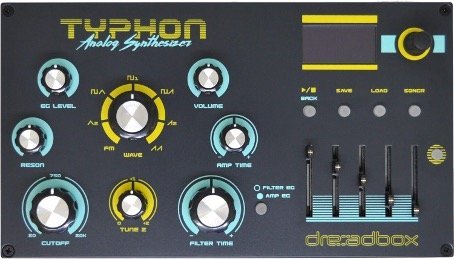
Dreadbox Typhon — analog core, big FX, dark pressure
A two-oscillator analog mono with serious modulation and Sinevibes FX in three slots – tight bass, gritty leads, and evolving motion in a tiny box that often lands in the sub-$400 range.
Best for
Dark techno basslines, aggressive leads, modulated sequences, gritty drones with FX-driven width. Small desks, live jams, and DAW-lite setups.
Sound & engine (plain-English)
Live players will appreciate why it’s in the best synthesizers 2025 for techno performance. Typhon’s two VCOs cover triangle → saw on Osc2 and pulse→square→saw on Osc1 (plus PWM), with detune ranges that glide between subtle and stepped semitones. A single 24 dB low-pass gives you classic mono cut, and cranking resonance moves from polite to self-osc for whistling peaks. The kicker is Filter FM from Osc2 and the Sinevibes FX: distort for bite, ensemble/chorus for motion, and lush reverb/delays that make one note feel huge. It’s a compact box that goes from clean + tight to filthy + cinematic fast. One of our alltime favourite which is why it easily landed in our best synthesizers 2025 list.
Workflow & learning curve
Eight “knob-per-function” controls + five context faders keep you oriented. Tap a section and the screen maps exactly what those faders do; a shift-style button toggles second pages. The modulation model is clear: pick M1/M2/M3 → choose type (LFO/Env/Random/Step) → assign multiple destinations (cutoff, osc pitch, FX mix, filter FM, delay time). Random has probability + slew, so modulation isn’t just jitter – it breathes. Build patterns with the note sequencer, then overlay mod step lanes for evolving timbre.
Build & I/O
Solid aluminum feel; MIDI in/out (5-pin), USB power (≥500 mA), stereo line outs (L/R), 3.5 mm mono input to the analog filter + FX, and headphone out. It integrates easily with DAWs or hardware clock sources and is small enough to live on any tier.
Highlights & Watch-outs
Quick patch recipe — “Industrial techno bass (clock-tight)”
- Osc mix: start with Osc1 square, bring in Osc2 saw; detune Osc2 a few cents.
- Filter: cutoff ~10–11 o’clock; resonance low-mid; add a slice of drive in the FX section.
- M1: LFO → cutoff (triangle), medium-slow, subtle depth for breathing.
- M2: Step sequencer → Filter FM (4–8 steps, small amounts) for metallic “bite” on select steps.
- M3: Step sequencer → delay time (short values) for rhythmic ticks; keep delay mix low.
- Record a 16-step bassline in the note sequencer; transpose from your MIDI keyboard. Tight, heavy, animated.
Bonus tricks
- “Fake” a noise source: route external noise/radio into the input, open VCA/filter, then shape + add FX—instant noise layer you can modulate.
- Pseudo-paraphony: use two mod step sequencers to drive Osc1 and Osc2 pitch separately; add reverb for chord-like blooms from a single held note.
- Karplus-Strong flavor: ultra-short delay times + feedback ring on their own—pluck-style tones from the FX path.
Alternative best synthesizers 2025 to audition next
Korg Monologue (more “immediate” mono with motion seq), Roland SE-02 (triple-VCO weight + onboard delay), Moog Subsequent 37 (premium mono heft).
Check Price
Get the best deal now.
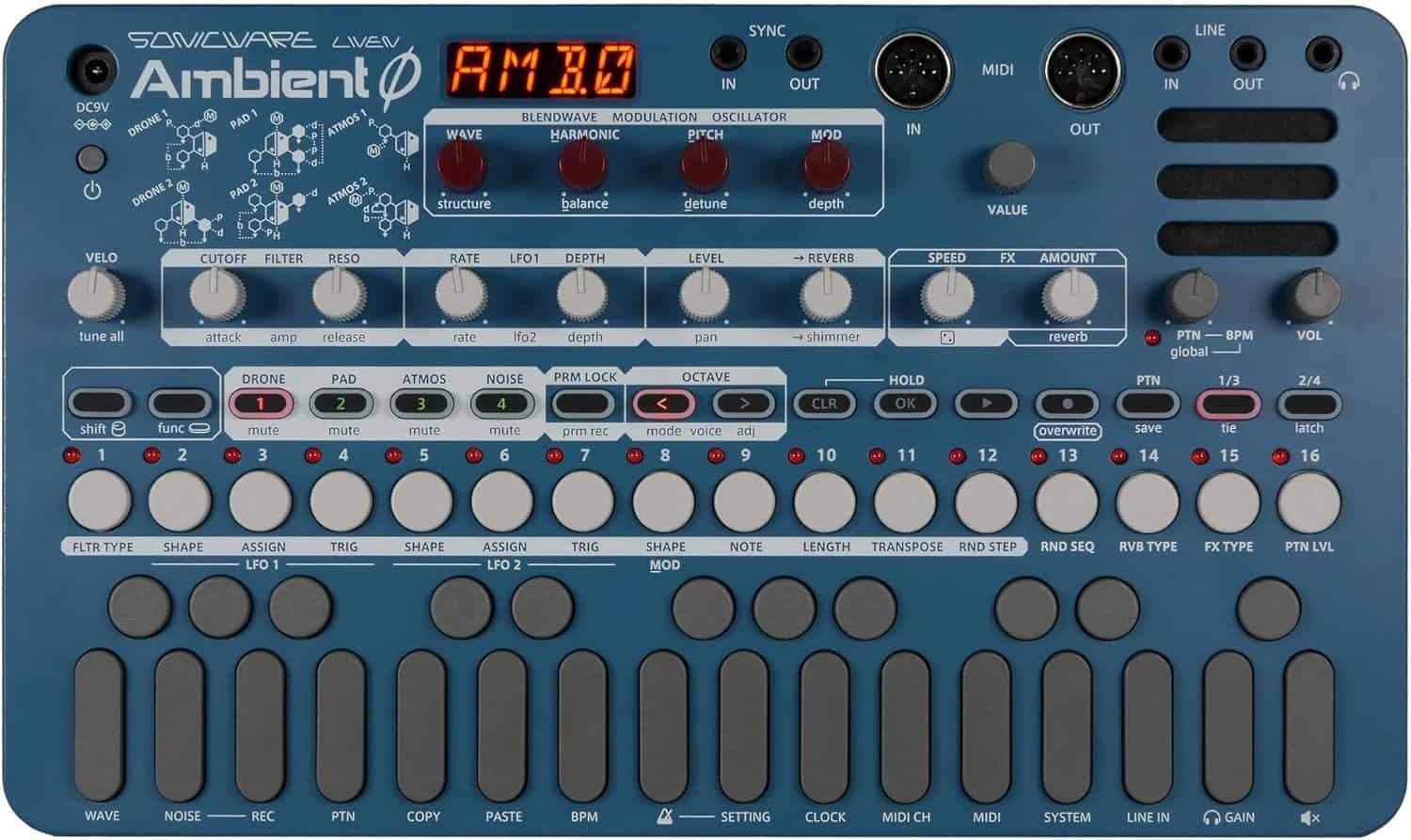
Sonicware LIVEN Ambient Ø – four-layer ambient groovebox with lush FX & line-in
A portable ambient groovebox with four dedicated layers (Drone, Pad, Atmos, Noise), a flexible per-layer sequencer, lush delay/reverb, and line-in effects—battery powered with a built-in speaker.
Best for
Among the best synthesizers 2025 for ambient, this one stands out for layered motion. Cinematic pads, drones, long-form ambient without a DAW, and travel-friendly writing sessions.
Sound & engine (plain-English)
Not just “a synth” but an ambient workstation: each layer offers oscillator choices, harmonic shaping, tuning, LFO, panning and filtering, then hits a lush reverb and delay. The result is clean, modern, and easy to stack—perfect if you want evolving space without external plugins.
Workflow & learning curve
Start with Hold for instant drones, then use the per-layer step counts/divisions to create slow phasing between parts. If you already own other gear, route it through line-in to use Ambient Ø as a spacey FX unit. Menus and dual-purpose buttons exist—set a simple template so you stay in flow.
Build & I/O
Compact, battery-powered, speaker on board, MIDI in/out, no USB. Buttons/knobs are serviceable but feel a bit clicky; it’s more tool than luxury object.
Highlights & Watch-outs
Quick patch recipe — “Slow breathing drone”
- Drone: low root note; filter slightly closed; slow LFO to cutoff.
- Pad: fifth above the root; longer attack/release; tiny chorus from the FX.
- Atmos: sparse high notes; step length different from Drone for gentle phasing.
- Noise: very low tape-like hiss for air; send everything to short stereo delay (L/R times slightly different) → long hall (low mix).
- Save as Template, then only vary step counts and LFO rates per layer.
Bonus tricks
- FX box mode: plug another synth to line-in and use Ambient Ø’s verbs/delays as your portable space.
- Minimalism wins: avoid filling all lanes—two purposeful layers often beat four crowded ones.
Alternative best synthesizers 2025 to audition next
Arturia PolyBrute 12 (if you want ambient with precise playability), Sequential Prophet 6 (brassy stereo dream pads, more conventional control), Walrus Audio SLOER Stereo Ambient Reverb (I know, this is not a Synthesizer, but a adding a great Effect Pedal makes almost every Syntheszier a great Ambient companien).
Check Price
Get the best deal now.
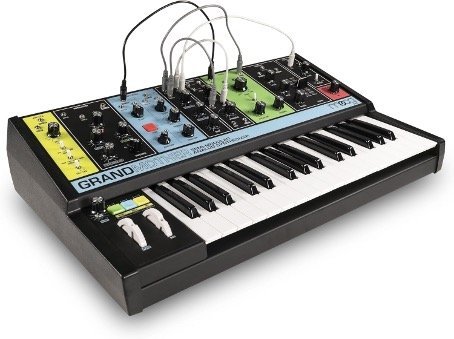
Moog Grandmother – hands-on patching with real spring reverb
A semi-modular analog synth with character – thick Moog tone, a real spring reverb, and a friendly patch bay that rewards exploration from minute one.
Best for
Hands-on learners, semi-modular explorers, vintage-flavored bass/leads with ladder filter weight, and ambient textures that love spring reverb.
Sound & engine (plain-English)
Under the hood: two main oscillators (tri/saw/square with PWM) into a classic 24 dB Moog ladder low-pass. The mixer can push harmonics before the filter; crank it for satisfying growl. The spring reverb turn simple tones into animated phrases without pedals. And because the LFO can become a tuned oscillator when patched to keyboard CV and routed into the mixer, you can run three-oscillator stacks or even paraphonic chord tricks.
Workflow & learning curve
It’s immediate: play, tweak, and patch where you look. The mod-wheel-to-LFO links pitch and cutoff depth/rate right from the panel, so expressive sweeps are a one-hand move. The attenuverter is a Swiss-army tool – scale/invert CV, or output a manual offset (up to ~8V) to extend ranges (e.g., Osc2 pitch). The patch bay exposes S&H, HPF, LFO sync to sequencer gate, and feedback tricks (route filter back to mixer) that most fixed-architecture boards hide in menus. The Grandmother is not only a great sounding synthesizer but also very good for learning synthesis as a beginner – clearly on of the best synthesizers 2025.
Build & I/O
Full-size keybed with velocity, solid chassis, rear jacks for MIDI/USB/audio, and CV points for Hold gate, Delay mod, and Voices (note: the voices don’t track 1V/Oct in a typical way – Grandmother is semi-modular first). Sequencer/arpeggiator are straightforward and flexible (random, fwd/bwd, legato ties, two glide modes).
Highlights & Watch-outs
Quick patch recipe — “Sync lead into spring”
- Hard sync ON (Osc2 slaved to Osc1).
- Osc mix: Osc1 saw, Osc2 square; detune Osc2 slightly.
- Filter: moderate cutoff, a touch of resonance; keyboard tracking on.
- Mod wheel ↔ LFO: assign to pitch for FM-ish edge; ride wheel for intensity, set LFO rate mid-fast.
- Spring reverb: push the mix until it starts to “sing,” then back off a notch; sprinkle delay if needed. This yields a vocal, tearing sync lead that feels alive under the whee
Bonus patch bay ideas
- Three-osc chords: patch LFO→KB and LFO out→Mixer to turn the LFO into Osc3; tune by ear; play paraphonic shapes.
- Band-pass flavor: patch the HPF in series with the LPF for a makeshift band-pass—great for animated mids.
- Tempo-locked motion: sync LFO to sequencer gate for rhythmically tight cutoff/pitch moves.
Alternative best synthesizers 2025 to audition next
Arturia MiniBrute 2 (semi-mod, different filter flavor), Behringer Crave (great for starting out), Moog Matriarch (bigger, 4-voice paraphony & stereo path).
Check Price
Get the best deal now.
How to choose your best synthesizers 2025
Analog vs digital vs VA: what’s the real difference in practice?
- Analog (VCO/VCF) gives you natural drift, saturation and “push-back” when you drive the filter. Basses and leads feel physical and sit in a mix fast.
- Digital (wavetable/FM/granular) gives you range: morphing pads, metallic plucks, vocal/formant tones, and complex movement with less noise.
- Virtual analog (VA) sits between—cleaner than VCOs, warmer than “hi-fi” digital, usually more affordable.
Decision tip: If you want characterful bass/lead → start analog. If you want evolving textures/sound design → start digital/wavetable. If you want one board to learn on → VA or hybrid (analog + digital osc/FX).
Mono or poly: do you actually need chords?
- Mono = one note at a time (bass/lead/sequence). Cheaper, simpler, very immediate.
- Poly = chords/pads. Costs more, needs more CPU/voices, but unlocks harmony and wide beds.
Reality check: Most beginners make 80% of early tracks with mono parts (bassline + lead). If you crave pads and chords, a small 4-voice (Minilogue-class) covers a lot without blowing the budget.
Keys or desktop: which format fits your space?
- Keys are grab-and-go and great for practice and gigs. Desktop saves money and space – perfect if you already own a MIDI keyboard. Also easier to stack on a small desk.
- Try this: If your room is tight or you plan multiple boxes, desktop versions first. Invest in one good controller you actually like to play.
Which specs really matter day to day?
- Envelopes: Snappy attack/decay = punchy bass/plucks. Slow attack/release = pads/ambient. Check if there’s a second envelope or a looping/cycling option.
- Modulation: LFO count, shapes, sync, and an easy way to route them. A mod matrix is great as long as it’s fast to use.
- Filter behavior: Does resonance kill low end? Is there drive? LP/BP/HP options?
- Sequencer & arp: Per-step automation (“motion recording”, parameter locks) is a huge creativity boost. You’ll use it.
- Aftertouch/expressivity: Channel or poly aftertouch makes pads and leads breathe. Even if the synth is desktop, check how it responds to AT from your controller.
- Patch memory: Beginners benefit from saving good sounds; semi-modulars are the exception.
- Built-in FX: Good chorus/delay/reverb = instant vibe. If a synth has no FX, plan for a pedal or plugin.
Semi-modular & CV/Gate: smart start or money pit?
Semi-modular is fantastic for learning synthesis by touch. You get a normalled (pre-wired) path that works with no cables, plus a patch bay to explore. It’s the missing link between “preset play” and “build your own voice.”
Caution: Set a budget and a goal. It’s easy to buy cables and modules you don’t need. Start with one semi-mod box (e.g., Grandmother/MiniBrute-class), add one utility you’re missing, then stop and make music.
Connectivity: what does the best synthesizers 2025 actually need?
- MIDI DIN/USB: DIN for hardware chains, USB for DAWs. If you gig, DIN is still king.
- Clock/Sync: If you love sequences, check for clock in/out or at least tight MIDI clock response.
- Audio outs: Balanced outs are a plus; desktop boxes often use unbalanced—just keep cables short.
- Headphone amp: Handy for late-night programming; some are much louder/cleaner than others.
- Pedals & CV: Expression pedal input = instant live dynamics. CV/Gate = modular fun (even without a rack).
Ergonomics: small wins that matter
- Panel density: Tiny knobs can be fine for studio use; harder on dark stages.
- Screen & labeling: Can you find key functions fast? If a synth is deep, does it have dedicated section buttons and a clear master control area?
- Sweet-spot design: Some synths feel “good almost everywhere” (you’ll finish more tracks). Others are powerful but fiddly (amazing for sound design rabbit holes).
Budget planning: where to spend, where to save
Spend on one instrument that makes you write: immediate workflow, sound you love, features you’ll actually touch. Save by:
- Choosing desktop over keys when possible.
- Buying a best synthesizers 2025 used from trusted sellers (synths hold value).
- Adding FX via plugins/pedals instead of chasing more synths.
Upgrade path without regret
- Start with a focused mono + a simple poly (or one hybrid that covers both bases).
- Add one wild card (wavetable/granular, or a semi-mod) from out best synthesizers 2025 list for creative contrast.
- When you outgrow a box, trade up; popular models resell well if you keep them mint.
Quick matchmaker (1-liners)
- “I want fat bass/leads now.” → Analog mono (Monologue/SE-02/Typhon).
- “I need pads and chords.” → At least 4-voice poly (Minilogue XD) or VA/wavetable (Hydrasynth/Argon).
- “I love evolving textures.” → Digital/wavetable or PolyBrute-class with morphing/mod depth.
- “I want to learn patching.” → Semi-modular (Grandmother/MiniBrute 2).
- “Tiny desk, small budget.” → Desktop units (Hydrasynth Desktop/SE-02/Typhon) + one good controller (like the Arturia Keystep).
Best synthesizers 2025 by Budget
Best synthesizers 2025: Under $500 — big ideas, small price
Arturia MicroFreak – winner best synthesizers 2025 (multi-engine + mod matrix)
A playful, paraphonic synth with a digital multi-engine (VA, wavetable, FM, formant, granular, more) into an analog multimode filter. The matrix makes routing dead simple; the arp/seq with “Dice/Spice” turns happy accidents into songs. Watch-outs: capacitive keys feel different; no built-in FX.
Best for: fast ideas, textures, talky tones, weird percussion.
Check price: Amazon
Korg Monologue – analog mono on a mission
Two VCOs + drive and a powerful motion-sequencer for animated bass/lead lines. It’s the most immediate “learn by doing” analog under $500. Watch-outs: one voice, 16-step limit, small keys.
Best for: techno/acid bass, gritty leads, drum-style step tricks.
Check price: Amazon
Yamaha Reface CS – tiny VA, instant fun
Virtual-analog engines on a super simple panel: set Texture/Mod and go. Great for pads, plucks, and airy leads in a backpack form factor. Watch-outs: mini keys, no aftertouch, modest I/O.
Best for: sketches, travel rigs, quick layering.
Check price: Amazon
Korg Volca Keys – ultra-budget character
Three-voice analog in a lunchbox. It can sound thin solo, but with drive/FX it’s a vibey layer that fits anywhere. Watch-outs: toy-ish build, limited control resolution, no patch memory.
Best for: quirky chords, lo-fi layers, learning sequencing.
Check price: Amazon
IK UNO Synth Pro (desktop) – deeper mono under ~$500
Dual filters, a broader mod matrix, and a flexible sequencer in a small desktop. Watch-outs: plastic build, menu layers; price hovers around the $500 line.
Best for: deeper mono design on a tight budget.
Check price: Amazon
Budget note: If you already own a MIDI controller, desktop units stretch your money further.
Hear the best synthesizers 2025 in action.
Best synthesizers 2025: Under $1,000 — modern engines, real depth
Korg Minilogue XD – winner best synthesizers 2025 (analog poly with digital brain)
4-voice analog with a digital multi-engine and user FX. Knob-forward, oscilloscope on board, quick to learn, still “keepers” tier. Watch-outs: four voices; simpler mod routing than true mod-matrix synths. Among the best synthesizers 2025 overall, this one stands out for fast results.
Best for: do-it-all starter poly that stays useful.
Check price: Amazon
ASM Hydrasynth Desktop – wavemorphing + macros
Wavemorphing oscillators, Mutants (FM/PWM, etc.), a clear mod matrix, and performance macros. Desktop saves money/space without losing the core engine. Watch-outs: digital by design; no keys. This lands in the best synthesizers 2025 for modern textures and deep modulation.
Best for: modern textures, evolving pads, macro-driven live tweaks.
Check price: Amazon
Modal Argon8 – smooth wavetable flavor
Clean, creamy wavetables with MPE support and good modulation options. Watch-outs: digital sheen isn’t for everyone; menu layers.
Best for: lush, evolving pads and polite mix fit.
Check price: Amazon
Korg Modwave – motion-sequenced wavetable beast
Deep wavetable engine + Motion Sequencing for rhythmic movement and macro-style control. Watch-outs: depth requires time; more “producer’s workstation” than knob-fest.
Best for: intricate sequences, animated pads, complex FX.
Check price: Amazon
Roland GAIA 2 – approachable VA + wavetable
Hands-on panel with immediate VA tones and a sprinkle of wavetable. Watch-outs: not Roland’s deepest engine; built-in FX do heavy lifting.
Best for: learners who want keys + simple path to modern sounds.
Check price: Amazon
Reality check: Under $1k is the sweet spot for first “serious” synths—enough depth to grow, not enough friction to stall.
Hear the best synthesizers 2025 in action.
Best synthesizers 2025: Over $1,000 — premium feel, performance power
Moog Subsequent 37 – winner best synthesizers 2025 (premium mono authority)
Two VCOs, hard sync, a killer ladder filter, and rock-solid performance features. Watch-outs: mono only; larger footprint than a desktop box.
Best for: flagship bass/lead with a “finished” sound.
Check price: Amazon
UDO Super 6 – binaural stereo dream
FPGA/analog hybrid with binaural stereo voice architecture; pads feel 3D without swimming in reverb. Watch-outs: not the cheapest; a distinct flavor.
Best for: wide, polished pads and modern leads with stereo motion.
Check price: Perfect Circuit
Sequential Prophet-6 – modern-built VCO classic with instant sweet spots
A six-voice VCO poly that nails the classic Sequential feel with instant sweet spots, a discrete LPF+HPF combo for tone shaping, and tasteful onboard FX. Poly Mod adds expressive movement without menu diving; the 64-step poly sequencer and arp make sketching fast.
Best for: classic poly duties, brassy stabs, warm pads—bread-and-butter sounds with polish.
Check price: Amazon
Sequential Take 5 – compact US-made poly
Five voices, punchy envelopes, solid modulation, and that unmistakable Sequential vibe. Watch-outs: 44-key range; voice count limits dense pads.
Best for: studio-ready poly parts in a smaller pro package.
Check price: Amazon
Pro move: Pick one premium center-piece, then add a cheap wildcard (MicroFreak/Monologue) for contrast. That combo covers 90% of tracks.
Hear the best synthesizers 2025 in action.
Best synthesizers 2025: Flagship ($3k+) – no-compromise feel & iconic tones
Arturia PolyBrute 12 – winner best synthesizers 2025 (expressive analog poly)
Morph between two scenes, push aftertouch, and live inside wide sweet spots. Big sound, big control, modern FX and sequencing. Watch-outs: large/heavy; deep enough to swallow sessions—set goals. It earns a spot in the best synthesizers 2025 thanks to expressive control.
Best for: cinematic pads, expressive leads, performance-driven sound design.
Check price: Amazon
Oberheim OB-X8 – classic OB tone across X/Xa/OB-8
Eight-voice VCO poly that blends OB-X/OB-Xa/OB-8 characters, with Split/Layer bi-timbrality and stereo pan modes for mix-ready width. Watch-outs: premium price; some power is on Page 2, so expect a short learning curve.
Best for: expressive pads/brass, vintage-leaning pop/film cues, stage splits.
Check price: Amazon
Sequential Prophet-10 Rev4 – modern build, vintage heart
Ten voices of classic Sequential tone with that unmistakable Prophet envelope snap. No onboard FX = pure signal path; pair with your favorite chorus/reverb. Watch-outs: limited modulation compared to hybrids; large, premium instrument. This belongs with the best synthesizers 2025 if you want instant sweet spots.
Best for: timeless polys, ’80s/modern pop beds, studio center-piece.
Check price: Amazon
UDO Super Gemini – binaural dual-engine flagship
Two full synth layers (per key) and binaural voice paths give pads/leads a 3D, hi-fi width without drowning in FX. Performance sliders and aftertouch make it a live beast. Watch-outs: size/weight; unique workflow worth a hands-on test.
Best for: wide, polished pads and animated stereo leads on stage.
Check price: Perfect Circuit
Flagship note: If your budget is open, try these in person—keybed feel, panel ergonomics, and stereo image matter as much as specs. A flagship + one cheap wildcard (MicroFreak/Monologue) covers 90% of tracks with contrast. If you just want the best synthesizers 2025, start with these two and you won’t go wrong.
Hear the best synthesizers 2025 in action.
Best synthesizers 2025 by Use-Case / Genre
Best synthesizers 2025 for Techno Bass / Acid Sequences
Dreadbox Typhon – winner best synthesizers 2025 (analog core + FX pressure)
Two analog VCOs into a steep low-pass and Sinevibes FX (drive/chorus/delay/reverb) give the Typhon heavy, modern bass. Mod lanes (LFO/Env/Random/step) make clock-tight filter FM hits, metallic stabs, and rhythmic delay ticks easy. Watch-outs: small screen/close controls; plan tempo-locked moves with step modulation. As one of the best synthesizers 2025 for value, it punches above its price.
Best for: dark basslines, gritty sequences, live jams.
Check price: Amazon
Moog Subsequent 37 – premium mono authority
Two VCOs + Moog ladder filter, snappy envelopes, Duo mode, arp/seq—this is “finished” bass right out of the box. It loves drive and resonance for pressurized, club-ready low end. Watch-outs: larger footprint; premium price; mono specialist. It’s firmly in the best synthesizers 2025 for live-friendly, knob-forward design.
Best for: massive bass hooks, acid-leaning leads, stage/studio reliability.
Check price: Amazon
Roland SE-02 – triple-VCO growl
Three oscillators, feedback circuit, onboard delay, and a sequencer in a Boutique box. Cross-mod from Osc 3 adds controlled aggression that reads well on PA systems. Watch-outs: tiny, closely spaced knobs; mono specialist.
Best for: weighty bass riffs, sequenced growl lines.
Check price: Amazon
Hear the best synthesizers 2025 in action.
Best synthesizers 2025 for Ambient Pads / Evolving Textures
Sonicware LIVEN Ambient Ø – winner best synthesizers 2025 (four-layer ambient groovebox w/ lush FX & line-in)
Four dedicated layers (Drone, Pad, Atmos, Noise), per-layer step counts/divisions for slow evolving motion, and lush delay/reverb that can also process external audio via line-in. Battery powered with a built-in speaker and MIDI I/O, it’s a portable ambient workstation. Watch-outs: polished digital core; menu/dual-function buttons; no USB; plastic/clicky feel.
Best for: cinematic pads, drones, long-form ambient without a DAW.
Check price: Amazon
Arturia PolyBrute 12 – morphing analog motion
Morph A↔B scenes and use aftertouch for breathing pads/leads. Dual filters, tasteful FX, and a sequencer with mod tracks build lush stereo beds without plugin stacks. Watch-outs: big/premium; depth can eat hours—set goals.
Best for: wide analog pads, expressive ambient themes.
Check price: Amazon
UDO Super 6 – binaural stereo dream
FPGA/analog hybrid with binaural voice paths; pads feel 3D even at low FX levels. Polished, airy, and mix-friendly. Watch-outs: higher price; distinct flavor. It joins the best synthesizers 2025 list for wide stereo presence out of the box.
Best for: pristine wides, modern scoring pads.
Check price: Perfect Circuit
Hear the best synthesizers 2025 in action.
Best synthesizers 2025 for Live Performance (grab-and-go, fast control)
Arturia MiniFreak – winner best synthesizers 2025 (dual engines + built-in FX)
Two digital engines per voice, hands-on mod matrix, arp/seq, and onboard FX make it a stage-friendly chameleon. Watch-outs: deeper than it looks—set performance macros.
Best for: versatile leads/keys, animated sequences, compact rigs. This makes the list of best synthesizers 2025 for its tone and workflow.
Check price: Amazon
Korg Minilogue XD – instant results on stage
4-voice analog + digital multi-engine with user FX. Obvious panel, oscilloscope for quick dialing, unison/chord/arp modes for flexible sets. Watch-outs: four voices; simpler mod routing than matrix synths.
Best for: bread-and-butter poly parts + quick textures.
Check price: Amazon
Novation Bass Station II – trusty live mono
Classic two-osc mono with sub, solid mod options, arp/seq, and a performance-ready panel. Cuts through a mix and travels well. Watch-outs: VA character; fewer FX—pair with a pedal.
Best for: assertive bass/leads, tight live control.
Check price: Amazon
Hear the best synthesizers 2025 in action.
Best synthesizers 2025 for Small Rooms / Studios
ASM Hydrasynth Desktop – winner best synthesizers 2025 (depth, tiny footprint)
Wavemorphing oscillators, Mutants, friendly mod matrix, and performance macros in a compact chassis. Desktop saves money/space but keeps flagship ideas. Watch-outs: digital character; needs a MIDI controller.
Best for: modern textures, template-driven sound design.
Check price: Amazon
Modal Argon8M – smooth wavetable module
Creamy, polite wavetables in a true desktop module. MPE support and solid modulation without hogging desk space. Watch-outs: menu layers; digital sheen isn’t for everyone.
Best for: evolving pads, melodic electronica on small desks.
Check price: Amazon
IK UNO Synth Pro (desktop) – deep mono, low space cost
Dual filters, broader mod matrix, flexible sequencer—serious mono tones in a light, compact unit. Watch-outs: plastic build; some menu navigation. It ranks in the best synthesizers 2025 for classic sounds with minimal setup.
Best for: complex mono parts when space is at a premium.
Check price: Amazon
Hear the best synthesizers 2025 in action.
Best synthesizers 2025 for Beginners / First Synth
Korg Monologue – winner best synthesizers 2025 (learn by doing)
Knob-forward panel, motion-seq, analog drive—every twist teaches synthesis while sounding good. Battery option sweetens practice anywhere. Watch-outs: one voice; 16-step ceiling.
Best for: bass/lead foundations, sequencing basics.
Check price: Amazon
Yamaha Reface CS – tiny VA, instant fun
Simple, direct VA engines with Texture/Mod controls; portable and musical. Great for learning envelopes/LFOs without menu diving. Watch-outs: mini keys; modest I/O; no aftertouch.
Best for: sketches, travel, quick layering.
Check price: Amazon
Roland GAIA 2 – approachable VA + wavetable
Hands-on panel, bread-and-butter sounds plus a sprinkle of wavetable. Easy way into synthesis on full keys. Watch-outs: not Roland’s deepest engine; FX do a lot of the heavy lifting.
Best for: first keyboard with a friendly learning curve.
Check price: Amazon
Best Synthesizer 2025 – Our Top Picks (Comparison Table)

 Best Overall | The best Synthesizer Overall. A four-voice analog poly with a fast, knob-forward workflow and a clever digital “multi-engine” on top - easy to learn, big enough to keep. |
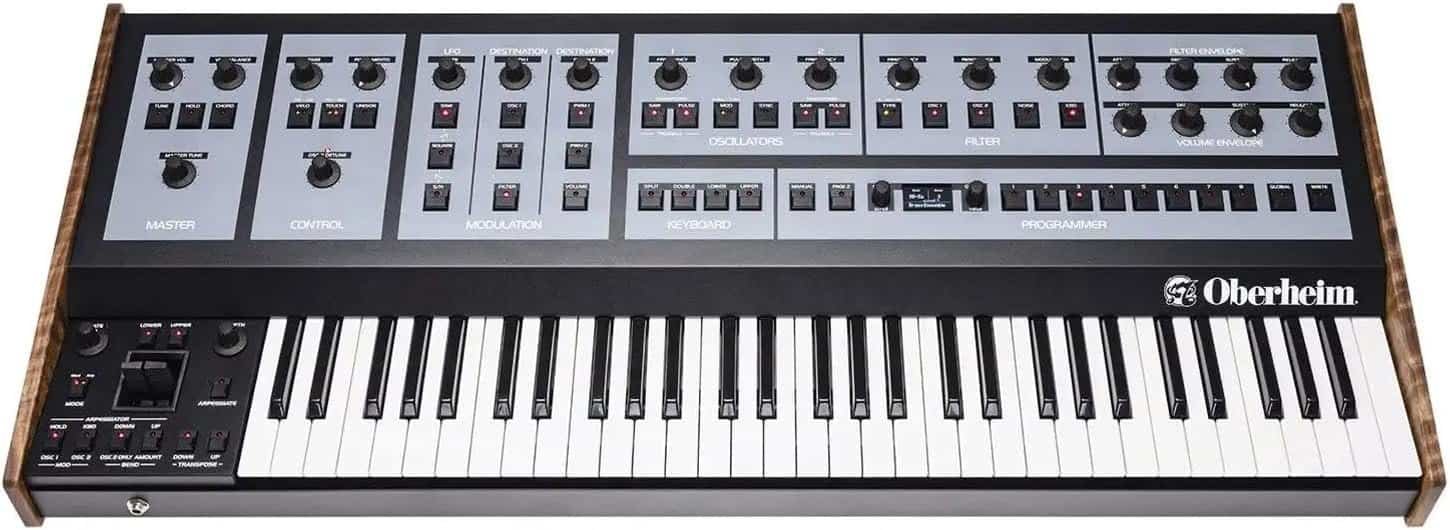 Best Flagship | The best Flagship Synthesizer. An eight-voice VCO analog poly that unifies OB-X, OB-Xa, and OB-8 flavors in one instrument—split/layer bi-timbrality, stereo pan modes, and extra SEM-style HP/BP/Notch filter types, all accessible via the infamous Page 2. |
Best over $1,000 | The best Synthesizer over $1,000. A performance-first analog poly that turns movement into part of the sound—morph scenes, play an ultra-expressive keybed, and shape big, modern tones fast. |
Best under $1,000 | The best Synthesizer under $1,000. Desktop price, flagship ideas—morphing oscillators, a generous mod matrix, and performance macros that make futuristic tones feel immediate. |
Best under $500 | The best Synthesizer under $500. A compact, paraphonic synth with a multi-engine digital oscillator, a SEM-inspired analog filter, and a mod matrix that makes creative sounds stupid-easy. |
Best Beginner | The best Beginner Synthesizer. A compact analog monosynth built for immediate bass/lead results and learn-by-doing synthesis—cheap to own, fun to sequence, hard to outgrow. |
Best Desktop | The best Desktop Synthesizer. A triple-VCO analog mono in a compact Boutique box—fat bass/leads, onboard sequencer and delay, plus clever cross-mod tricks when you want bite. |
Best for Techno Bass | The best Synthesizer for Techno Bass. A two-oscillator analog mono with serious modulation and Sinevibes FX in three slots—tight bass, gritty leads, and evolving motion in a tiny box that often lands in the sub-$400 range. |
Best for Ambient | The best Ambient Synthesizer. A portable ambient groovebox with four dedicated layers (Drone, Pad, Atmos, Noise), a flexible per-layer sequencer, lush delay/reverb, and line-in effects—battery powered with a built-in speaker. |
Best Semi-Modular | The best Semi-Modular Synthesizer. A semi-modular analog synth with character—thick Moog tone, a real spring reverb, and a friendly patch bay that rewards exploration from minute one. |
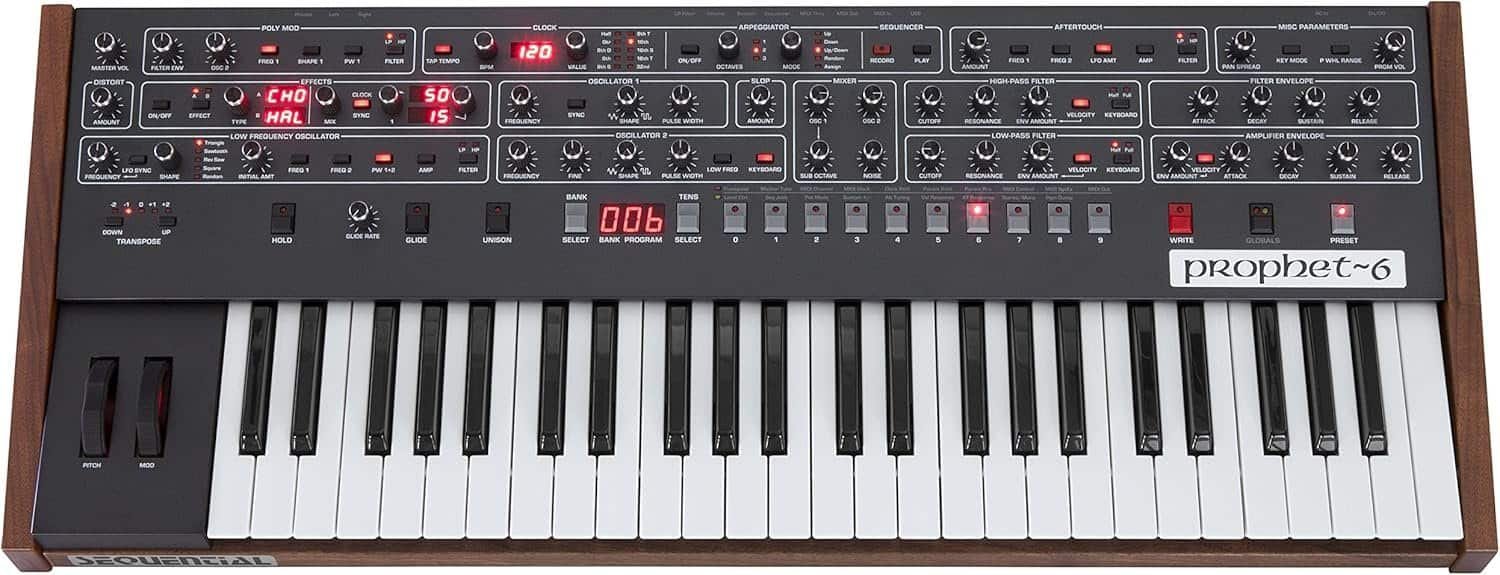 Runner Up | Our Runner Up Synthesizer. Modern-built VCO classic with instant sweet spots, HPF+LPF tone shaping, tasteful onboard FX, and that unmistakable Sequential punch. |

Quick Patch Recipes
Snappy Bass (tight, mix-ready)
Goal: fast attack, short body, focused lows that don’t get muddy.
Steps
- Oscillators: start with one square or saw. If two oscs, detune very slightly (±3 cents) or tune Osc2 = +7 semitones for weight + edge.
- Filter: low-pass ~10–11 o’clock, resonance low. Enable key tracking ~50–100% to keep brightness consistent across notes.
- Amp envelope (ADSR): A = 0–5 ms, D = short, S = low/0, R = short.
- Filter envelope: small positive amount; A = 0–5 ms, D = short-medium for a percussive “nip.”
- Drive/saturation: add just a touch—you want presence, not fuzz.
- Sub: if available, bring a sub-osc up slightly; or layer Osc2 one octave down.
- Finish: high-pass sidechain EQ (or cut <35–40 Hz) to make room for the kick.
Per-synth quick wins
- SE-02: use feedback at low settings; try Osc3 as mod for PWM or a hint of filter FM.
- Monologue: set LFO = one-shot → cutoff for that punch; motion-record a few cutoff steps for groove.
- Typhon: M2 Step-Seq → Filter FM on a few steps for metallic snap; touch of Sinevibes drive.
- Minilogue XD: enable drive; optional: layer a digital sine quietly for sub focus.
Wide Lush Pad (warm and breathing)
Goal: stereo width, slow movement, gentle top end; plays nice with vocals.
Steps
- Oscillators: two saws, slight detune; optionally add a triangle low in the mix for body.
- Filter: low-pass ~11 o’clock, resonance minimal; engage key tracking ~50%.
- Amp envelope: A = 300–800 ms, D = medium, S = medium-high, R = 600–1200 ms.
- Filter envelope: small positive amount; A = slow (200–500 ms) for a soft bloom.
- LFO: slow triangle/sine to PWM or cutoff; rate = 0.1–0.3 Hz, depth subtle.
- Stereo & FX: chorus/ensemble → short stereo delay → hall/plate reverb (low mix).
- Clean-up: roll off <120 Hz on the pad bus; a tiny high-shelf dip at 8–10 kHz if fizzy.
Per-synth quick wins
- PolyBrute 12: set Scene A = darker, Scene B = brighter, then Morph via aftertouch for living motion.
- Hydrasynth: Macro 1 = wavescan pos, Macro 2 = filter brightness, Macro 3 = chorus mix; assign light random to scan pos.
- Minilogue XD: use user FX (chorus/ensemble) + reverb; try a digital shimmer oscillator very low for sheen.
Tight & Bright Pluck (melodic arps, keys)
Goal: percussive attack, quick decay, controlled brightness that cuts without harshness.
Steps
- Oscillator: saw or pulse (narrow PWM for bite). Single osc is fine.
- Filter: start more open (~1–2 o’clock), resonance moderate for a clicky transient.
- Amp envelope: A = 0–10 ms, D = short-medium, S = 0–10%, R = short.
- Filter envelope: A = 0, D = short, Amt = medium so the pluck “speaks” then tucks in.
- Mod: tiny velocity → amp and velocity → cutoff for expressive dynamics.
- FX: short stereo delay (1–3 repeats), mild plate; keep mixes low.
- Arp: set up/down, 1/8 or 1/16, small swing if needed.
Per-synth quick wins
- MicroFreak: use Karplus-Strong or SawX; Cycling Env → cutoff; record 2 mod lanes in the sequencer for subtle motion.
- Hydrasynth: Mutant = PWM or FM lightly; Macro 1 = brightness; add short room in FX.
- SE-02: ease in cross-mod (Osc3 → PWM or filter FM) for sparkle; micro-detune Osc2.
Evolving Texture (slow, cinematic)
Goal: long, shifting tone with controlled chaos; no rhythmic “lumps.”
Steps
- Sound source: choose a wavetable or two saws detuned; or a noisy/inharmonic oscillator model.
- Filters: gently low-pass one path; leave another path brighter (if available) for contrast.
- Mod layers: two very slow LFOs (0.05–0.15 Hz) to cutoff, waveshape, or pan; add random S&H at tiny depth to a 3rd parameter.
- Envelopes: Amp = slow A/D/R; optionally loop an envelope on a subtle destination (eg. FM index).
- Space: chorus/ensemble → stereo delay (different L/R times) → long reverb (low mix).
- Macro/Performance: assign 1–2 macros to “Brightness/Movement” so you can swell the scene hands-on.
- Mix discipline: high-pass at ~120–180 Hz; tame 2–4 kHz if texture fights vocals.
Per-synth quick wins
- LIVEN Ambient Ø: Hold to drone on the Drone layer; set different step lengths/divisions per layer for slow phasing; slow LFO → cutoff/pan; keep Atmos sparse, Noise very low for air; FX: short stereo delay (offset L/R) → long hall; save as a template and tweak only rates; use line-in to wash external synths.
- Hydrasynth: build an 8-slot wavescan; Macro 1 = scan pos, Macro 2 = chorus, Macro 3 = reverb; add Mutant (FM) very low.
- Grandmother: use spring reverb + feedback (filter→mixer); LFO → cutoff super slow; try S&H drifts; patch HPF+LPF in series for band-pass shimmer.
- Typhon: M1 slow LFO → cutoff, M2/M3 = step lanes with long lengths to FX mix and Filter FM for glacial shifts.
Troubleshooting your patch (quick call-outs)
- Bass lacks punch? Increase filter env amount; shorten amp decay; add a hint of drive.
- Pad too muddy? Lower reverb mix, add chorus first; cut <120 Hz; reduce detune and resonance.
- Pluck too harsh? Lower resonance, close filter slightly, or dip 3–5 kHz; shorten delay feedback.
- Texture gets lumpy/rhythmic? Desync one LFO; use different, very slow rates; reduce modulation depth.
- Loses level when resonance up? Add filter drive or blend a sub/sine quietly.
- Phasey low end? Collapse the pad’s lows to mono; keep width above ~150 Hz.
Tiny cheatsheet (typical ranges)
- Snappy bass: Attack 0–5 ms • Filter cutoff 10–11 o’clock • Env Amt small-med • Drive low
- Lush pad: Attack 300–800 ms • Release 600–1200 ms • Cutoff 10–11 o’clock • LFO 0.1–0.3 Hz
- Bright pluck: Filter open 1–2 o’clock • Env Amt med • Decay short-med • Delay short, low mix
- Evolving texture: Two LFOs <0.2 Hz • Random tiny depth • Long verb low mix • HP @120–180 Hz
Analog vs Digital vs VA
(what actually matters in practice)
The short version
- Analog (VCO/VCF): physical drift, natural saturation, immediate bass/lead weight.
You hear: warmth, slight motion, chewy filter drive.
Watch-outs: fewer voices for the money, less flexible modulation, tuning/temperature quirks. - Digital (wavetable/FM/granular): huge range, precise control, evolving textures.
You hear: glassy highs, morphing timbres, clean stereo effects.
Watch-outs: can feel “clinical” if you don’t add movement/saturation; menus if the UI isn’t great. - Virtual Analog (VA): digital engine emulating subtractive analog, usually simpler UI and priced well.
You hear: “analog-ish” tones with cleaner behavior and modern conveniences.
Watch-outs: not all VAs are equal—some rely on FX for vibe.
Decision tip: If you want fat bass/lead now, start analog. If you want evolving pads/textures, start digital. If you want one board to learn on, a good VA or hybrid is the least fussy path. To keep it simple, start with the best synthesizers 2025 listed above and grow from there.
Analog (why people still love it)
- Mix weight: Basses and leads sit quickly; ladder/OTA filters add pleasant thickness when pushed.
- Hands-on feel: Most analogs are “what you touch is what you hear.”
- Character: Subtle drift and nonlinearities make repeated parts feel less copy-pasted.
When analog bites back
- Voices vs. budget: 4 voices can be enough—but dense pads will voice-steal.
- Tuning & warm-up: Modern analogs auto-tune, but give them a minute.
- Mod depth: Without a matrix, complex routings are limited (trade speed for depth).
Reality check: If your tracks are 80% mono parts (bass/lead), a mono analog + small poly later is a smarter spend than one huge flagship.
Digital (wavetable / FM / granular)
- Range & recall: From glass plucks to metallic swells to vocal-ish formants—plus perfect preset recall.
- Motion without FX: Wavetable position, FM index, granular density = movement at the oscillator level.
- Stereo done right: Chorus, delays, and reverbs are often studio-grade.
Avoid the “too clean” trap
- Add small random mod to pitch/filter/WT pos.
- Use mild drive or tape sim to seat sounds.
- Layer a simple analog or sampled analog for body if needed.
Budget note: Under $1k, digital (or hybrid) gives you more voices and modulation per euro.
Virtual Analog (VA)
- Why VA works: Familiar subtractive flow, low CPU/voice cost, quick to program live.
- Great for learning: Clear oscillator→filter→envelope path; good for band/keys work.
- Sound: Many VAs are “polite”—they shine with chorus + delay and a touch of saturation.
Watch-outs: Some VA boards rely on FX to feel big; bypass FX to judge the core tone.
Hybrids (best of both)
- Analog filter + digital oscillators/FX is a sweet spot: warm filtering, modern timbres, built-in polish.
- You keep mix weight from the filter and the range from the oscillator/FX section.
- Examples on this page: Minilogue XD (analog core + digital multi-engine), MicroFreak (digital osc + analog filter).
Pro move: Pair one analog (mono or small poly) with one digital/wavetable box. You’ll finish more tracks with contrast than two similar synths.
In the mix: quick heuristics
- Bass losing low end at high resonance? Add filter drive or blend a sub sine.
- Pads too fizzy? Low-pass a bit earlier, chorus before reverb, and roll off <120 Hz.
- Digital sounds too “pointy”? Add a hair of saturation, reduce pre-FX highs, and use short, wide delay instead of huge reverb.
- Analog getting muddy? Tighter envelopes, slightly higher cutoff, and gentle HPF on the bus.
Try-before-you-buy checklist
- Play it dry: turn off FX and judge the core tone.
- Twist the filter: does resonance kill bass? Is there a pleasing drive?
- Check envelopes: can you go snappy and slow-lush convincingly?
- Mod one thing: how fast is it to route LFO/Env to cutoff or pitch?
- Headphones + monitors: make sure you like it in both contexts.
Best synthesizers 2025 – Methodology
How we pick (real-world > spec sheets)
What counts as the best synthesizers 2025 depends on tone, workflow, and budget.
- Playability & speed: Best synthesizers 2025 turn ideas into sound fast – clear panels, sensible defaults, and modulation you’ll actually touch. “One idea per knob” beats a buried feature every time.
- Sound in a mix: To get on the list for best synthesizers 2025 – Patches must sit without a fight. We listen on monitors and headphones, dry first, then with modest FX. Bass weight, transient snap, and mid clarity matter more than lab numbers.
- Range vs. focus: We balance character (e.g., ladder warmth) with range (e.g., wavetable morphing) so a single instrument can cover multiple roles in a small studio.
- Reliability & ecosystem: Firmware maturity, editors/librarians, preset management, I/O, community support, and availability/price stability all influence picks.
- Evidence base: Besides hands-on priorities, we cross-check claims with deep model notes and guides you provided (PolyBrute 12, Hydrasynth, Minilogue XD, MicroFreak, Monologue, SE-02, Typhon, LYRA-8, Grandmother), along with broader buyer lists (budget tiers).
Update cadence. We revisit this page quarterly and after major firmware/hardware releases. Price/stock are checked across your partner retailers before each revision. Independence. Retailer links can earn us a commission at no extra cost to you. Picks are editorial – no paid placements, and affiliates don’t get to approve content.
Conclusion & Next Steps
Short version: you don’t need ten synths – you need one instrument that makes you write. If you want instant bass/lead results, start with a focused mono (Typhon, SE-02, Subsequent 37). If pads and chords are your thing, a compact poly like Minilogue XD or a digital/wavetable engine like Hydrasynth Desktop (with your favorite controller) will cover huge ground. For texture lovers, PolyBrute 12 and LYRA-8 turn movement into music without drowning in plugins. Keep it simple, map a few performance controls, and finish tracks.
When you’re ready to grow, add one contrasting voice (analog ↔ digital, mono ↔ poly) and a single character FX (chorus/delay/reverb or a drive/tape flavor). That combo beats a room full of “almosts.”
Check price & availability: Amazon
(Use the buttons in each pick; links are affiliate and help the site at no extra cost.)
Your next steps
- Pick your lane: Bass/lead mono → Typhon / SE-02 / Subsequent 37.
Pads/keys → Minilogue XD / Hydrasynth Desktop. - Grab one and learn it: Save 10 go-to patches (bass, pad, pluck, texture).
- Map performance: Aftertouch/modwheel/macros to Brightness, Vibrato, Space.
- Record a 4-track sketch: Kick, bass, lead, pad—keep FX light.
- Revisit this guide quarterly: We update after major firmware/hardware releases.
Keep exploring
- Best Analog Synths → /synthesizers/best-analog-synths/
- Best Monosynths → /synthesizers/best-monosynths/
- Audio Interfaces for Hardware Synths → /audio-interfaces/interfaces-for-hardware-synths/
- Best VST Synths → /plugins/best-vst-synths/
About the Author

Patrick is a Germany-based producer and synth. He spends most days writing, tracking hardware, and testing gear in small real-world sessions—no lab coats, just songs.
This guide follows the same approach: fast, musical results first; specs only when they change what you can actually do.
Patrick has programmed and reviewed a wide range of instruments—from compact monos like SE-02, Monologue, and Typhon to expressive polys like Hydrasynth and PolyBrute.
He values clear panels, reliable tuning, and sounds that sit in a mix without a fight. When he says a synth is a “keeper,” it’s because it helped finish tracks. Have a question or a correction?
Reach out via the Contact page and check the Affiliate Disclosure to see how links support the site at no extra cost to you.
FAQ
These FAQs cover the best synthesizers 2025 basics.
Do I need a polysynth to start?
Not necessarily. Most early tracks lean on mono parts (bass/lead/sequences). If you crave pads and chords, a small 4-voice (e.g., Minilogue XD) is a great add-on, but a punchy mono will teach you faster and slot into more mixes.
Can I make “pad-like” sounds with a mono?
Yes—just differently. Use long attack/release, low filter cutoff, and gentle modulation; record overdubs or use paraphony/duo modes if available. It won’t replace a true poly, but you’ll get lush layers that work in real songs.
Desktop module or keyboard – what’s better for a small room?
Go desktop if you already own a MIDI controller or want to stack gear on a tiny desk. Choose keys if you play live or prefer a grab-and-go instrument that’s always ready without extra cables.
Are built-in FX enough, or should I add pedals/plugins?
Good onboard chorus/delay/reverb gets you 80% there and speeds up writing. For character, add one external flavor (a loved plugin reverb, a tape/drive pedal) rather than buying a second synth to “fix” ambiance.
How many voices do I really need?
For pop/electronic pads, 4 voices are fine with simple voicings; 6–8 gives more headroom for sustained chords. If you mostly do bass/lead, 1 voice (mono) is still the fastest way to great results.
Semi-modular as a first synth – smart or risky?
Smart, if you’re curious and disciplined. Semi-modulars work unpatched and invite learning; just set a budget and add only one or two utilities after you hit a creative wall—otherwise it becomes an endless rabbit hole.
Do I need an audio interface to use a hardware synth?
You can start with your computer’s input or a small mixer, but a dedicated interface improves noise, headroom, and latency. If you plan to track stereo FX or multiple synths, get an interface with at least 2 inputs to start.
What’s the difference between aftertouch and poly aftertouch?
Aftertouch (channel) applies pressure data to the whole sound; poly aftertouch applies it per key. Channel AT is great for filter swells or vibrato; poly AT lets you shape individual notes in a chord—amazing for pads and expressive leads.
Will a digital/wavetable synth sound too “clean”?
Only if you leave it static. Add small random modulation, a touch of drive/saturation, and short, wide delays before long reverb; layer with an analog or a simple sine for body if needed.
Can I perform without a built-in sequencer?
Yes. An arp plus your DAW or an external sequencer (hardware or app) covers most needs. Built-in sequencers are convenient on stage, but not mandatory.
Still have more questions?
Glossary
ADSR (Attack, Decay, Sustain, Release): The classic envelope shape that controls how a sound starts, fades, holds, and ends. Used for amp loudness and for shaping filter brightness.
Aftertouch (channel / poly): Pressure data sent after the initial key strike. Channel affects the whole sound; poly affects each note separately for expressive pads and leads.
Analog (synthesis): Circuits generate/shape sound continuously (VCO/VCF/VCA). Known for warmth, drift, and pleasing saturation when pushed.
Arpeggiator (Arp): Automatically cycles through notes you hold to create rhythmic patterns. Different modes (up, down, random) change the feel fast.
Binaural (stereo voice paths): Left and right channels run slightly different processing. Creates wide, 3D pads without heavy reverb.
BP / HP / LP (band-pass / high-pass / low-pass): Filter types that keep a band, highs, or lows and remove the rest. LP is the subtractive staple for warm, darker tones.
CV/Gate: Control voltage (CV) moves parameters; Gate signals note on/off. The language of modular and semi-modular synths.
Cycle (looping) envelope: An envelope that can loop like an LFO but with envelope curves. Great for evolving motion without using up LFOs.
Delay (ping-pong / stereo): Echo effect; ping-pong bounces between left and right. Short times add groove; long times create space.
Digital (wavetable/FM/granular): DSP-generated sound with huge range and precise control. Can feel “clean” until you add movement and saturation.
Duo / Paraphony: Play two or more notes that share parts of the signal path (often one filter/envelope). More chord-like than mono, lighter than true polyphony.
Drive / Saturation: Harmonic distortion that adds body and presence. Use lightly to recover low end lost to high resonance.
Envelope (EG): A time-based shape used to control loudness, filter cutoff, pitch, etc. Most synths have at least an amp envelope; many add a second for the filter.
FM (frequency modulation): One oscillator modulates another’s frequency to create bells, metallic tones, and complex harmonics. Small amounts add nice edge.
Granular (engine): Splits audio into tiny grains and recombines them for smeared, evolving textures. Handy for pads and sound design.
Hard Sync (oscillator sync): Forces Osc2 to restart with Osc1; sweeping Osc2 pitch creates vocal, tearing leads.
Hybrid (analog + digital): Mixes analog filters/VCAs with digital oscillators/FX. Warm filtering with modern timbres and recall.
Key tracking (keyboard follow): Ties filter cutoff (or other params) to note pitch so higher notes stay brighter and consistent.
Ladder / Steiner (filter flavors): Common analog filter designs: Ladder = round, bass-friendly; Steiner = sharper, more aggressive resonance.
LFO (low-frequency oscillator): Slow modulation source for vibrato, tremolo, filter sweeps, and rhythmic movement. Sync to tempo for tight grooves.
Macro (performance control): One knob/fader that moves several parameters at once. Perfect for live sweeps like “Brightness” or “Space”.
MIDI / CC: Digital protocol to connect/control gear. CC (control change) messages move parameters (filter cutoff, mod depth, etc.).
Mod Matrix (modulation matrix): Routing hub to send sources (LFO, envelopes, velocity) to destinations (cutoff, pitch, effects). Depth + clarity = power you’ll actually use.
MPE (MIDI Polyphonic Expression): Per-note pitch/pressure/slide data from compatible controllers. Lets chords breathe like multiple solo instruments.
Oscillator (VCO/DCO/VA): The sound source (saw, square, triangle, noise…). VCO = analog, DCO = digitally controlled analog, VA = virtual analog (digital emulation).
Oscilloscope (onboard): Tiny screen that shows the waveform so you can “see” what your tweaks do. Great for learning.
Pitch Glide / Portamento: Slides smoothly between notes. Short times add legato vibe; longer times do classic glide leads.
Polyphony: Number of notes a synth can play at once. More voices help with pads/chords; 4 is enough for simple voicings.
PWM (pulse-width modulation): Modulates square-wave width for chewy, chorus-like motion without effects.
Random / S&H (sample & hold): Stepped random modulation; great for organic wobble or retro sci-fi bleeps.
Resonance (Q): Emphasizes frequencies around the filter cutoff. Low = round; high = whistly. Too much can thin bass—add drive or a sub.
Ring Modulation: Multiplies two signals for metallic, bell-like sidebands. Subtle mixes add shimmer; high amounts get clangy.
Sequencer (note / parameter): Plays programmed note patterns; many units also record parameter moves (“motion”/“locks”) per step.
Spring Reverb: Physical reverb using a spring tank; splashy, vintage character that pairs well with analog tones.
Stereo spread / width: Small left-right differences in time, pitch, or filtering to create size. Keep low frequencies centered for a clean mix.
Sync (tempo): Locks LFOs/delays/sequencers to BPM so movement lands on the grid. Essential for tight electronic patterns.
Unison / Detune: Stacks voices on one note for thickness; a little detune adds width, too much gets out of tune.
VA (virtual analog): Digital engine mimicking analog subtractive synthesis. Friendly workflow, great value, and easy live control.
Wavefolding / Waveshaping: Nonlinear processing that folds or bends the waveform to add bright, complex harmonics.
Wavetable / Wavescan: Moves through multiple single-cycle waves for evolving tone. Wavescan lets you define a list and sweep across it smoothly.
1V/Oct (scaling): Common analog pitch standard—each volt equals one octave. Some semi-modulars use CV creatively and don’t track 1V/Oct on every input.